The Spanish Bargain: Seven Years of No, Then a Contract
Columbus did not simply ask Spain for ships. He asked for a fortune, a title, and a dynasty. For nearly seven years the Spanish court said no — and then, in the spring of 1492, in the afterglow of a great military victory, it said yes to almost everything he wanted. The contract they signed, the Capitulations of Santa Fe, made Columbus an admiral, a viceroy, a governor, and a partner in the profits of any lands he found. It also set up the quarrels that would end with him in chains eight years later.
In short
After Portugal rejected his plan in 1484–85, Columbus spent nearly seven years petitioning Ferdinand and Isabella of Spain. A royal commission rejected the plan in 1490. After the fall of Granada in January 1492, the monarchs reversed course and signed the Capitulations of Santa Fe on 17 April 1492, granting Columbus the hereditary titles of Admiral of the Ocean Sea, Viceroy and Governor-General of any lands he discovered, and 10 percent of all riches brought home, with an option to invest one-eighth of the costs for one-eighth of the profits.
The court that said no
Spain in the 1480s was not a single country but a partnership of two crowns: Ferdinand of Aragon and Isabella of Castile, married in 1469, ruling together as the Catholic Monarchs. They were in the middle of the Granada War, a ten-year campaign to conquer the last Muslim kingdom on the Iberian Peninsula, and their court moved with the army, from camp to camp. Columbus arrived in 1485 with his young son Diego and began the long business of getting an audience — waiting in antechambers, finding patrons, and explaining his plan to anyone who would listen.
His most important early supporter was the Franciscan friar Juan Pérez of the monastery of La Rábida, near Palos, who believed in the plan and helped Columbus reach the court. Another was Antonio de Marchena, a friar and cosmographer. But the plan itself went to a commission headed by Hernando de Talavera, Isabella's confessor, and the commission did what expert committees usually do: it asked for evidence, checked the figures, and found them wanting. The distance to Asia was too great, the costs too uncertain, and the rewards too speculative. In 1490 the commission rejected the plan. Columbus was offered, at most, a polite dismissal.
It is worth pausing on why the Spanish court hesitated, because the hesitation was reasonable. Spain had spent a decade and a fortune on the Granada War. The treasury was strained. Columbus was a foreigner — a Genoese with no university degree, no noble birth, and a plan that contradicted the best geography of the day. And his demands were extraordinary: he did not ask for a salary but for a share of an empire, with titles to pass to his sons. To a royal council, that looked less like a proposal and more like a gamble by a man with nothing to lose. The wonder is not that they said no for seven years. The wonder is that they eventually said yes.
Granada falls, and the mood changes
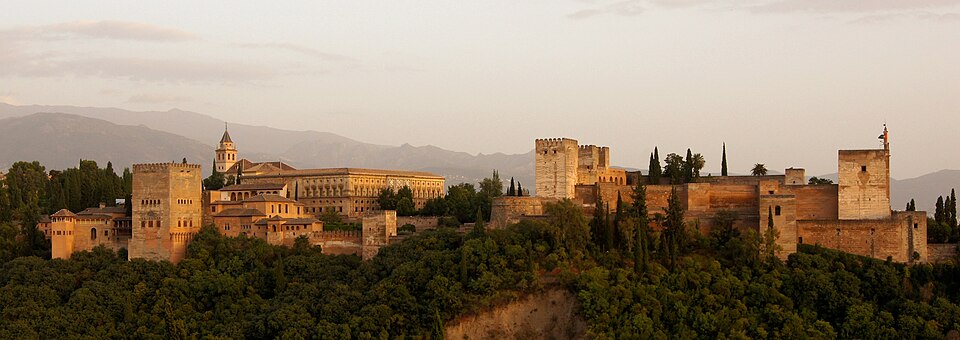
On 2 January 1492, after a ten-year war, the city of Granada surrendered. The last Muslim ruler of Spain, Boabdil, handed over the keys of the Alhambra, and Ferdinand and Isabella entered the city in triumph. The Reconquista — the centuries-long Christian reconquest of Iberia — was complete. The court was in a mood of celebration and confidence, and the monarchs were thinking about what came next. Spain had an army, a navy, and a sense of divine mission; the question was where to direct it. The same year, the monarchs also issued the Alhambra Decree expelling the Jews from Spain — a reminder that the triumphant mood of 1492 had a dark side, and that the Spain Columbus sailed for was a country in the middle of a fierce religious transformation.
It was in this atmosphere that Luis de Santángel, the Aragonese finance official, made the case for Columbus. The cost was modest — roughly the price of a few weeks of court entertaining, by some estimates — and the possible prize was enormous: a direct route to the spice trade, new lands for the Crown, and new souls for the Church. Santángel offered to help raise the money himself. Isabella, who had been the more sympathetic of the two monarchs, agreed. Ferdinand, who had been sceptical, went along. The story that Columbus was already riding toward France when a messenger caught up with him may be embellished, but it captures the truth: the decision came late, suddenly, and only after years of refusal.
The Capitulations of Santa Fe
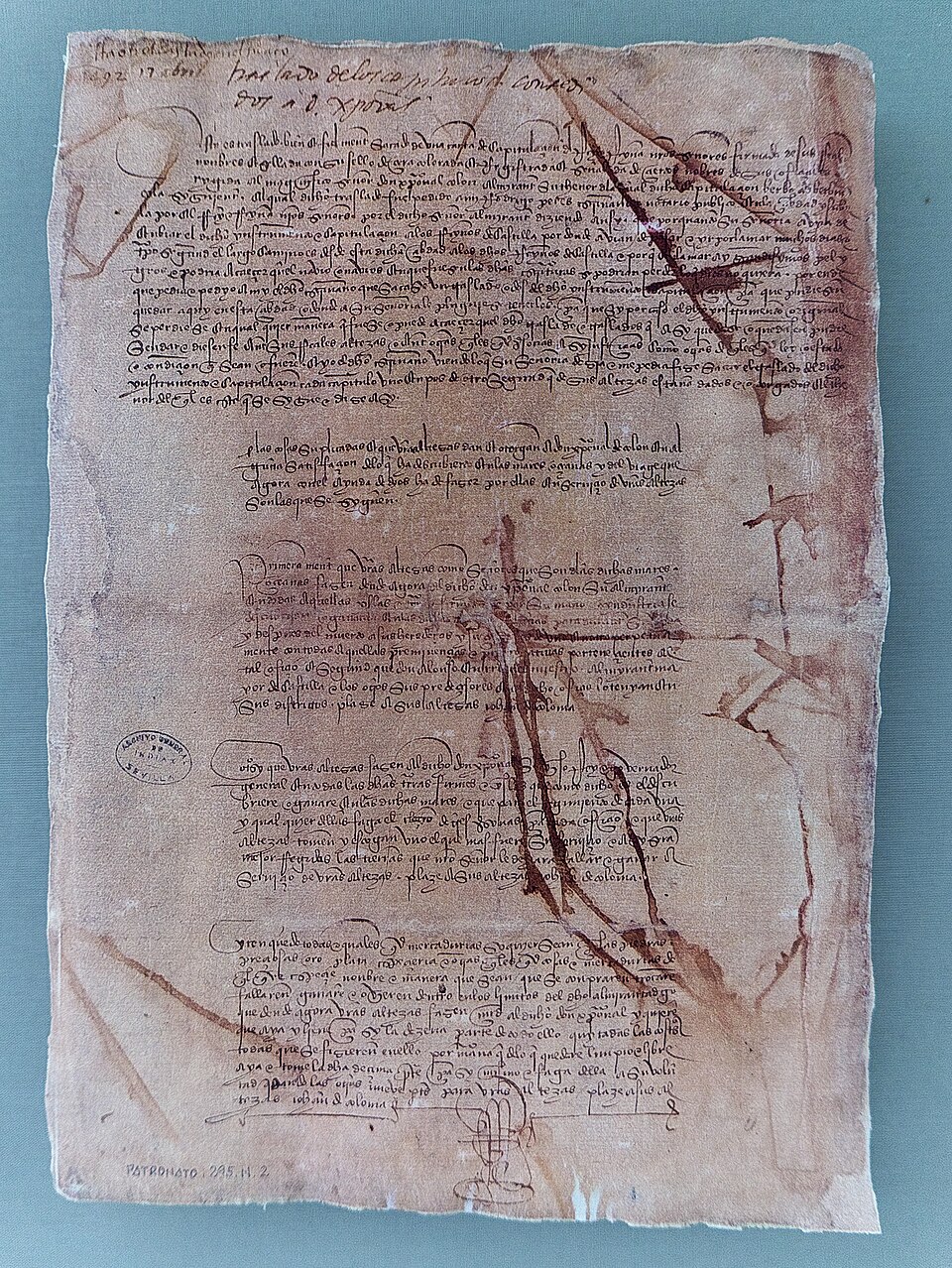
The agreement was signed on 17 April 1492 at Santa Fe, the siege camp outside Granada. Its terms were remarkable, and they explain both Columbus's later power and his later fall. The monarchs granted him the hereditary title of Admiral of the Ocean Sea, with all the honours and privileges that went with it. They made him Viceroy and Governor-General of all lands he discovered, with the right to nominate officials. They promised him one-tenth of all gold, silver, spices, and other merchandise obtained in those lands. And they gave him the option of investing one-eighth of the cost of any future expedition in exchange for one-eighth of the profits.
The Capitulations were the first document to establish an administrative organisation for the Indies — before there was any proof the Indies existed. They made Columbus, in effect, a partner of the Crown rather than its employee, and they gave his family a permanent stake in the enterprise. That was the bargain's strength and its weakness. As long as the voyages produced gold and glory, Columbus was untouchable. When the colony on Hispaniola turned into a mess of rebellion, disease, and complaints, the same contract made him a problem: a viceroy the Crown could not control, with rights it could not easily take back. In 1500, when the monarchs sent Francisco de Bobadilla to investigate, they did not formally break the contract — they simply sent a man with the power to ignore it. Columbus kept his titles after his arrest, but the titles were, as one historian puts it, thereafter empty of authority.
The law that divided the world
The bargain with Columbus was only the first of the legal documents that shaped his story. Once he returned in 1493 with news of new lands, Spain moved quickly to secure its claim against Portugal, which argued that the new islands fell within its own sphere. The monarchs asked Pope Alexander VI — a Spaniard by birth, Rodrigo Borgia — for confirmation. On 4 May 1493 the pope issued the bull Inter caetera, granting Spain the lands west of a line drawn through the Atlantic, and a second bull, Dudum siquidem, on 26 September 1493 extended the grant. Portugal objected, and the two kingdoms negotiated directly: the Treaty of Tordesillas, signed on 7 June 1494, moved the line to 370 leagues west of the Cape Verde Islands, giving Spain most of the Americas and Portugal Africa, Asia, and — as it turned out — Brazil, which Pedro Álvares Cabral reached in 1500 on the Portuguese side of the line. The treaty was confirmed by Pope Julius II in 1506.
These documents matter because they show how the voyages were understood at the time: not as the discovery of a new world, but as the legal acquisition of new territory for a European crown, authorised by the pope and divided by treaty between two Christian kingdoms. The peoples who already lived in those lands were not consulted, and their consent was not considered necessary. That assumption — that a pope could grant and two kings could divide lands they had never seen — is one of the things historians argue about most fiercely today, and it is the legal foundation on which the entire Spanish empire in the Americas was built.
| Date | Document or event | What it did |
|---|---|---|
| 2 Jan 1492 | Fall of Granada | End of the Reconquista; monarchs free to back new ventures |
| 17 Apr 1492 | Capitulations of Santa Fe | Admiral, Viceroy, Governor-General titles; 10% of riches |
| 30 Apr 1492 | Royal privileges confirmed | Hereditary titles and profit share put in writing |
| 4 May 1493 | Inter caetera (Pope Alexander VI) | Granted Spain lands west of a papal line |
| 26 Sep 1493 | Dudum siquidem | Extended the Spanish grant |
| 7 Jun 1494 | Treaty of Tordesillas | Spain and Portugal split the world at 370 leagues west of Cape Verde |
| 24 Jan 1506 | Ea quae pro bono pacis (Pope Julius II) | Confirmed the Treaty of Tordesillas |
Sources: ScienceABC, “Why Were Christopher Columbus' Voyages Backed by the Spanish Monarchy?”; Wikipedia, “Spanish Empire” and “Capitulations of Santa Fe”; Guiding America, “Capitulations of Santa Fe”; Encyclopedia.com. Checked 29 November 2026.